Encrypted Messaging Showdown: Signal vs. Session vs. Matrix for High-Risk Communications
An architectural evaluation of end-to-end encryption protocols, central server metadata exposure, onion routing, and decentralized federation for journalists and confidential sources.
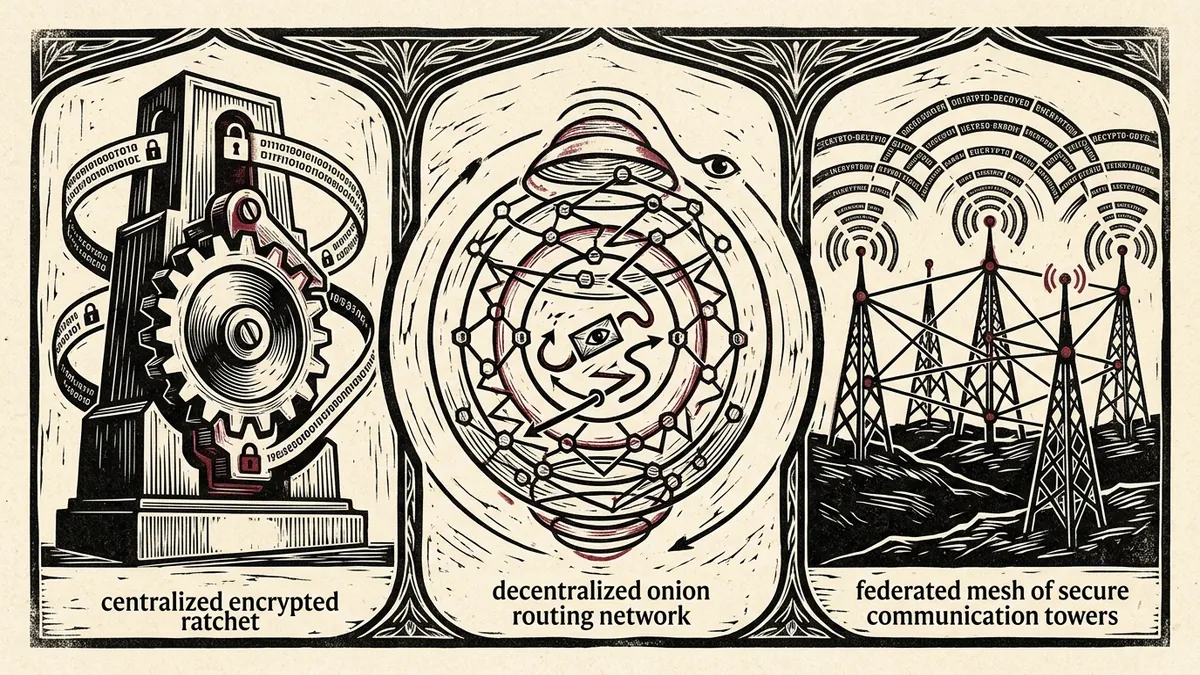
When investigating state corruption, defense procurement, or human rights atrocities, the fundamental operational vulnerability is rarely the content of a message; it is the metadata surrounding the message. As former NSA General Counsel Stewart Baker famously remarked: “Metadata absolutely tells you everything about somebody’s life. If you have enough metadata, you don’t really need content.”
Knowing that a confidential source exchanged twelve messages with an investigative reporter at 02:00 AM immediately preceding a front-page exposé is sufficient for an intelligence agency or corporate adversary to identify and prosecute the source, even if the text itself was cryptographically scrambled.
As outlined in our overarching Digital Security Blueprint for Journalists, selecting a secure communications platform requires balancing cryptographic strength, metadata minimization, and infrastructural trust. This guide delivers a technical, architectural audit of the three premier encrypted messaging frameworks: Signal, Session, and Matrix.
The Protocol Architecture Spectrum
           CENTRALIZED                           DECENTRALIZED                        FEDERATED
         ┌─────────────┐                       ┌─────────────┐                     ┌─────────────┐
         │   SIGNAL    │                       │   SESSION   │                     │   MATRIX    │
         └─────────────┘                       └─────────────┘                     └─────────────┘
                │                                     │                                   │
      Central Server Entity                Multi-Hop Onion Swarm               Inter-Server Mesh
     (Signal Foundation AWS)             (Oxen Service Node Network)          (Self-Hosted Synapse)
                │                                     │                                   │
        Double Ratchet                       Decentralized Ratchet                    Olm / Megolm
       (Sealed Sender)                       (Zero Central State)                 (Room State Copies)
1. Signal: The Cryptographic Gold Standard
Maintained by the non-profit Signal Technology Foundation, Signal remains the baseline recommendation for consumer and journalistic end-to-end encryption (E2EE).
Cryptographic Innovations:
- The Double Ratchet Algorithm: Combines a symmetric-key ratchet with a Diffie-Hellman (DH) ratchet. Every individual message generates a new, ephemeral cryptographic key. If an adversary compromises a key at 14:00, they cannot decrypt past messages (Perfect Forward Secrecy) nor future messages (Post-Compromise Security / Future Secrecy).
- Sealed Sender: Traditional encrypted messages still transmit the sender’s account identifier in cleartext to the central server so the server knows who sent it. Signal’s Sealed Sender encapsulates the sender’s identity inside the encrypted envelope; the Signal server only sees the recipient’s delivery token.
The Subpoena Test:
Signal’s structural defense has been repeatedly tested in United States federal courts. When served with grand jury subpoenas, Signal Foundation could provide only two data points: 1. The unix timestamp of account creation. 2. The unix timestamp of the account’s last connection to the Signal server. Zero message contents, zero contact lists, zero group memberships, and zero communication logs exist on Signal’s infrastructure.
Weaknesses & Operational Risks:
- Centralized Dependency: Signal relies on centralized servers hosted primarily on AWS. A government can order telecom providers to block access to Signal servers via IP blacklisting or SNI filtering (as seen in Iran and Russia).
- Phone Number Legacy: While Signal has introduced user-facing usernames, the underlying account is still tied to a telephone number, exposing investigators to SIM-swapping attacks unless a dedicated VOIP burner is deployed.
2. Session: The Metadata-Free Decentralized Swarm
Built by the OPTF (Open Privacy Technologies Foundation), Session is an open-source, private messenger engineered specifically to eliminate central server metadata and telecom dependencies.
Architectural Innovations:
- No Phone Numbers, No Email: When you install Session, you generate a 66-character public hex key (e.g.,
05a4f7e2...). Your identity is a public cryptographic key pair; no telecommunications identifier is ever requested. - Onion-Routed Message Swarms (Lokinet): Session does not operate central servers. Messages are wrapped in three layers of encryption (analogous to Tor) and routed through a decentralized network of incentivized service nodes. Each node knows only the previous hop and the next hop; no single computer knows both who sent the message and who received it.
- Local Offline Storage: Messages reside in ephemeral node memory (“swarms”) for a maximum of 14 days before automated deletion, then exist solely on the user’s physical device.
Weaknesses & Operational Risks:
- Latency: Because messages traverse multi-hop decentralized onion routing, message delivery and attachment transfers experience perceptible latency compared to Signal.
- Voice and Video Limitations: Real-time peer-to-peer audio and video calls require bypassing onion routing to establish direct WebRTC connections, potentially exposing IP addresses unless paired with an audited no-logs VPN service.
3. Matrix / Element: Sovereign Newsroom Infrastructure
Matrix is not an app; it is an open, decentralized standard for secure, real-time communication. Clients like Element connect to independent Matrix “homeservers.”
Architectural Innovations:
- Institutional Data Sovereignty: An independent investigative newsroom can deploy its own Matrix homeserver (using the
SynapseorDendritebackend) on an air-gapped or hardened sovereign server. All newsroom communications remain entirely on hardware owned and controlled by the publication. - Olm and Megolm Cryptography: Implements double ratchet encryption adapted for multi-user chat rooms with thousands of concurrent participants.
- Open Interoperability: Matrix supports native bridging into IRC, Slack, and other enterprise messaging networks.
Weaknesses & Operational Risks:
- Homeserver Metadata Exposure: Matrix encrypts message text and attachments, but room membership metadata, user display names, and event timestamps are visible to the administrator of the homeserver. If you join a public Matrix room hosted on a compromised server, that server’s operator can log your account’s IP address and presence patterns.
- Administrative Complexity: Hosting a secure Matrix homeserver requires dedicated systems administration, continuous TLS certificate management, and regular security patching.
Technical Audit & Comparison Matrix
| Security Feature | Signal | Session | Matrix (Self-Hosted) |
|---|---|---|---|
| Primary Protocol | Signal Protocol (Double Ratchet) | Session Protocol (Onion Swarm) | Olm / Megolm (MLS Hybrid) |
| Account Identifier | Phone Number (with Username overlay) | 66-char Cryptographic Hex Key | Username @user:domain.com |
| Server Architecture | Centralized (Signal Foundation / AWS) | Decentralized (Oxen Onion Network) | Federated / Self-Hosted Sovereign |
| IP Address Exposure | Hidden via Sealed Sender / Proxies | Hidden via 3-Hop Onion Routing | Visible to Homeserver Administrator |
| Subpoena Resistance | High (Cryptographically enforced) | Absolute (No central server exists) | Depends on Server Jurisdiction |
| Voice / Video Quality | Exceptional (Low latency) | Basic / P2P IP Leak risk | Robust (via Jitsi / LiveKit bridges) |
| Best Operational Role | Everyday high-security messaging | Ultra-high-risk source intake | Internal newsroom collaboration |
Operational Recommendations for Investigative Teams
- For Everyday Field Operations: Deploy Signal. Require all reporters to enable Disappearing Messages (set to 24 hours or 1 week) to prevent forensic discovery if devices are physically confiscated at border checkpoints.
- For High-Risk Anonymous Whistleblowers: Direct the source to Session. Share your 66-character Session ID on public portfolios or encrypted bios. The source can communicate without purchasing a burner SIM or exposing a phone carrier record.
- For Newsroom Internal Infrastructure: Deploy a self-hosted Matrix Synapse server. Ensure all database disks are encrypted via LUKS, and enforce FIDO2 hardware key authentication for all staff members.
By deploying the appropriate tool for each specific operational tier, investigative teams insulate themselves and their sources against digital dragnet surveillance.
For private, zero-upload inspection of local evidence files, launch our client-side Digital Media Verification Navigator.
Put This Methodology Into Practice
Test these forensic workflows directly inside our client-side verification engine. Inspect EXIF headers in memory, calculate cryptographic file fingerprints, and run automated error level analysis with zero data leaving your device.
Launch Digital Verification Navigator →About the Contributor
The Dawat Digital Rights & Security Desk analyzes cryptographic protocols, metadata retention laws, and secure telecommunications infrastructure.