The Politics of Translation: Preserving Cultural Nuance in Non-Western Prose
An inquiry into postcolonial translation ethics: resisting Anglo-American domestication, the limits of algorithmic machine translation, and preserving regional Persian and Pashto idioms.
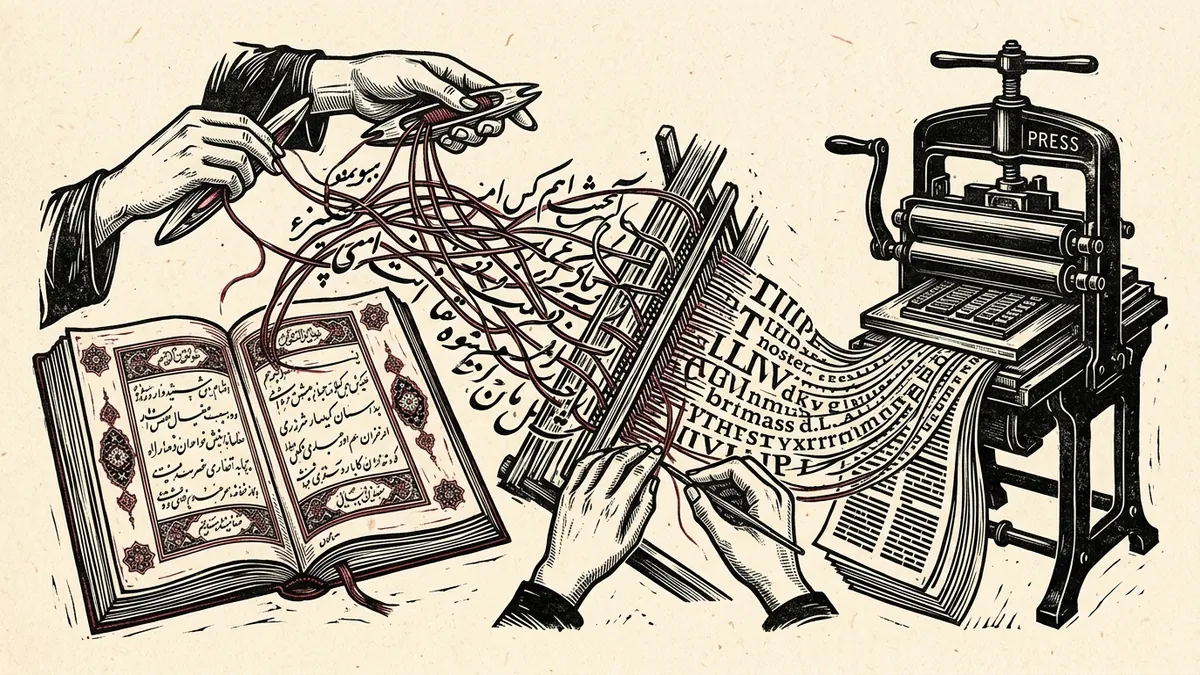
Translation is never an innocent linguistic exchange. It is a site of geopolitical power, ideological negotiation, and cultural filtration. When a novel, memoir, or historical document from a non-Western society is translated into English or French, it crosses an asymmetrical border: from a marginalized linguistic sphere into the dominant global idiom of the post-industrial West.
As articulated in our foundational monograph on Diaspora Literature in the 21st Century, the translator holds the power either to preserve the sovereign strangeness of the original culture or to sanitize it into digestible commercial prose. For over twenty years, Dawat Free Media’s translation desk has examined this tension—evaluating how Persian, Pashto, and Central Asian texts are translated, adapted, and occasionally mutilated for international audiences.
This critical inquiry examines postcolonial translation ethics, the debate between domestication and foreignization, and why the rise of automated neural translation models threatens regional literary diversity.
1. The Violence of Domestication: Lawrence Venuti’s Paradigm
In his seminal 1995 treatise, The Translator’s Invisibility: A History of Translation, comparative literature scholar Lawrence Venuti identified the primary pathology of Anglo-American publishing: Domestication.
                   THE DUAL STRATEGIES OF LITERARY TRANSLATION

         DOMESTICATION                             FOREIGNIZATION
    (Anglo-American Commercial Standard)      (Postcolonial Ethical Standard)
    ┌──────────────────────────────────┐      ┌──────────────────────────────────┐
    │ • Erases foreign syntactic quirks│      │ • Retains original cultural idioms│
    │ • Replaces local metaphors with  │      │ • Preserves untranslated terms   │
    │   Western colloquialisms         │      │ • Forces dominant language to    │
    │ • Gives illusion text was born   │        expand and adapt                 │
    │   in English                     │      │ • Reminds reader: you are a guest│
    └──────────────────────────────────┘      └──────────────────────────────────┘
When Western commercial publishers commission translations of Persian (Dari) or Pashto novels, the prevailing editorial demand is “fluency” and “seamless readability.” Editors insist on scrubbing away repetition, flattening intricate syntactic inversions, and substituting Anglo-Saxon idioms for Islamic or regional metaphors: * When a grieving mother exclaims in Persian: “Janam ba lab rasid” (literally: “My soul has arrived at my lips”), a domesticating translator reduces this evocative physiological metaphor to: “I was exhausted.” * When a protagonist invokes “Nang wa Namoos” (the inviolable honor code of Pashtun lineage), domesticating prose flattens it to: “reputation.”
This process constitutes what Venuti calls an act of ethnocentric violence: it colonizes the foreign text, reassuring the Western reader that all human cultures think, mourn, and structure reality using standard American middle-class syntax.
The Counter-Strategy: Foreignization. Ethical postcolonial translation deliberately leaves foreign syntactic pressure on the receiving language. It forces English to stretch, buckle, and absorb the rhythmic cadence of the original tongue, reminding the reader that they are entering an ancient, sovereign imaginative space.
2. Gayatri Spivak and the Erotics of Surrender
In The Politics of Translation (1993), postcolonial theorist Gayatri Chakravorty Spivak warned against treating translation as a mere technical transfer of semantic dictionaries.
Spivak argues that translation requires an ethical surrender to the text—a willingness to inhabit the historical, theological, and gendered realities of the original language before attempting to reproduce it:
“Translation is the most intimate act of reading. Unless the translator has earned the right to become the intimate reader, she cannot surrender to the text, cannot respond to its special call.”
Spivak identifies that Western feminist and political translators frequently project contemporary Western liberal concepts onto non-Western historical subjects: * When translating Afghan women’s poetry (such as the folk Landays examined in our study on Oral Literature and Vanishing Traditions), commercial translators often frame rural village women as individualized secular rebels, misinterpreting their grief and religious piety through Western individualist paradigms. * True translation ethics requires recognizing that resistance in non-Western prose frequently operates through religious vocabulary, communal kinship duties, and complex family loyalties rather than individualistic self-actualization.
3. The Anatomy of Untranslatability: Regional Idioms
Certain linguistic constructs in Central-South Asian letters resist direct bilingual equivalence. To translate them is to diminish them:
| Regional Concept | Language | Literal Sense | Inadequate Western Translation | Authentic Cultural Significance |
|---|---|---|---|---|
| Ta’arof (تعارف) | Persian | Mutual cultural deference | “Politeness / Etiquette” | A sophisticated social ritual of reciprocal generosity, status negotiation, and emotional consideration. |
| Arman (ارمان) | Pashto / Persian | Longing anchored in sorrow | “Regret / Wish” | A profound, lifelong philosophical ache for an unrealized state of justice, love, or homeland. |
| Melmastia (مېلمستیا) | Pashto | Radical hospitality | “Hospitality / Welcome” | An inviolable tenet of Pashtunwali requiring asylum and total physical protection for any guest, even an enemy. |
| Ghayrat (غیرت) | Arabic / Persian / Pashto | Moral courage and defense | “Jealousy / Pride” | The ethical duty to defend the vulnerable, protect familial dignity, and resist tyranny. |
In the works of diaspora authors like Khaled Hosseini, these terms are consciously retained in their original script and phonetics (jan, baba, harami, kolba). The author refuses to provide immediate explanatory crutches, compelling the reader to infer meaning from narrative context.
4. The Peril of Algorithmic & Neural Machine Translation
The rise of Large Language Models (LLMs) and commercial neural machine translation engines (Google Translate, DeepL) has introduced a new, insidious form of linguistic monoculture.
                    THE ALGORITHMIC HOMOGENIZATION SPIRAL

    Regional Nuance (Dari / Pashto / Uzbek)
    [Metaphors, Sufi Allegory, Dialectal Inversions]
                    │
                    ▼ (Processed via Silicon Valley LLM)
    [Trained 85%+ on Western Commercial Web Corpora]
                    │
                    ▼
    Standard Corporate Global English
    [Sanitized, Grammatically Rigid, Culturally Sanitized]
Why AI Fails Literary Translation:
- Statistical Probability vs. Poetic Innovation: LLMs predict the most statistically probable next token based on billions of crawled web pages. But literary brilliance in poetry and prose lies precisely in improbable metaphor—the radical syntactic leap that breaks standard speech patterns.
- Dialectal Blind Spots: Machine translation models are trained predominantly on formal, standard written registers (e.g., Iranian Persian). When applied to Afghan Dari or regional Herati idioms, they routinely misinterpret regional vocabulary as grammatical errors, converting vibrant dialect into lifeless textbook prose.
- The Erasure of Double Entendres: Persian and Urdu literature relies extensively on Iham (amphibology—deliberate double meanings where a word simultaneously signifies mystical divine devotion and earthly romantic love). Algorithms collapse this poetic ambiguity into a single, flat literal reading.
5. The Ethics of the Footnote and the Paratext
How should an ethical translator navigate the gap between source and target audiences?
The traditional Western publishing mandate disdains footnotes in literary fiction, claiming they “break immersion.” However, for postcolonial and non-Western translations, the thoughtful translator’s preface and contextual endnotes are instruments of decolonization: * They make visible the labor of translation, disproving the myth of the “invisible translator.” * They provide historical context for regional political rivalries, theological debates, and geographical realities that cannot be integrated into dialogue without awkward didacticism. * They celebrate linguistic friction rather than erasing it.
Conclusion: Translation as Hospitality
In classical Pashto culture, the principle of Melmastia dictates that when a stranger enters your home, you do not force them to dress in your clothes or speak in your cadence; you welcome them as they are, offering your finest carpets and sweetest tea while honoring their distinct identity.
Translation, at its highest ethical threshold, is an act of radical cultural hospitality. The translator does not drag the foreign author across the border, strip them of their regional idioms, and force them to speak suburban American English. Rather, the ethical translator invites the global reader to step across the frontier, remove their shoes, and listen attentively to a voice that belongs to another world.
Explore our literary monographs in Critical Themes in Khaled Hosseini, or examine oral history in Vanishing Folk Traditions.
Put This Methodology Into Practice
Test these forensic workflows directly inside our client-side verification engine. Inspect EXIF headers in memory, calculate cryptographic file fingerprints, and run automated error level analysis with zero data leaving your device.
Launch Digital Verification Navigator →About the Contributor
Dr. Rahmat Rabi Qazi is a literary historian, translator, and senior archival contributor to Dawat Free Media, specializing in Central-South Asian diaspora letters and postcolonial prose.