Vanishing Folk Traditions and the Preservation of Oral Literature in Central-South Asia
Documenting the subversive genius of the Pashto Landay, bardic epic traditions along the Oxus, and digital audio protocols for archiving endangered oral cultures.
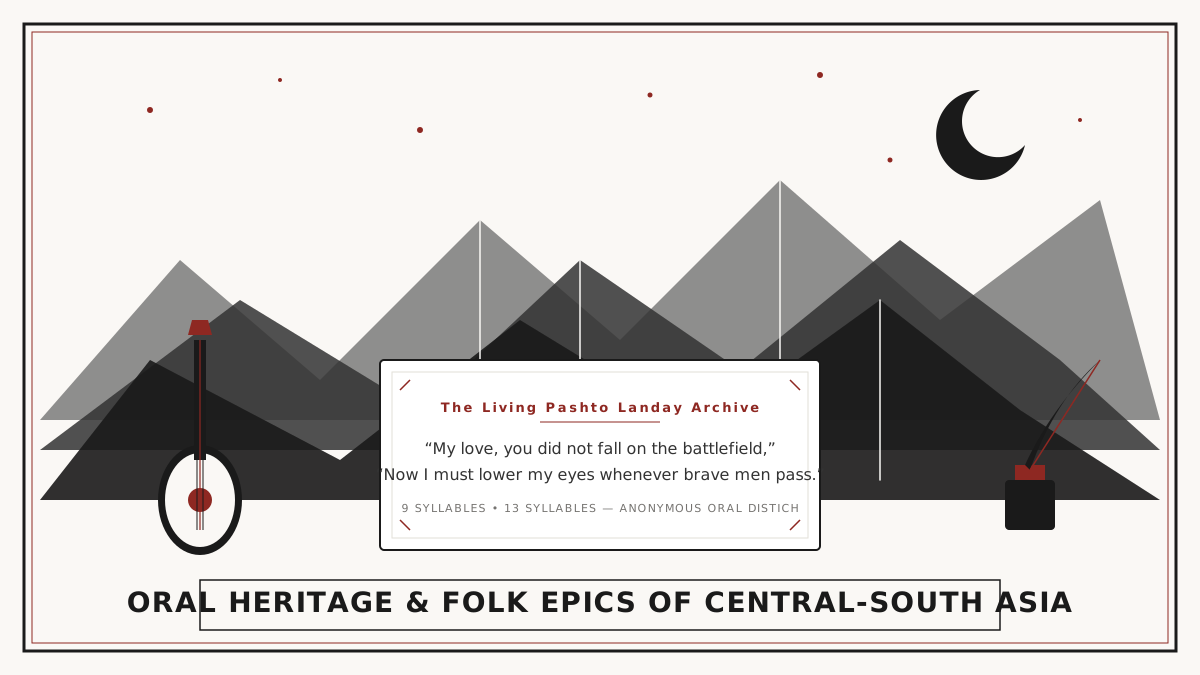
When war, forced migration, and political terror fracture a society, physical monuments are not the only casualties. Minarets can be rebuilt and libraries can be restocked, but when an oral storytelling tradition is severed, thousands of years of unrecorded human philosophy, female dissent, and communal memory vanish irrevocably into silence.
As explored in our overarching inquiry on Diaspora Literature in the 21st Century: Exile, Memory, and Cultural Reclamation, written literature represents only the visible tip of regional cultural identity. Throughout Central and South Asia—across the rugged valleys of the Hindu Kush, the steppes bordering the Oxus River, and the pastoral migration routes of Balochistan—the primary repository of history has always been the human voice.
Since our founding in 2004, Dawat Free Media has documented this fragile oral heritage. This archival monograph examines the subversive poetic architecture of the Pashto Landay, the epic bardic memory traditions of the Silk Road, and the ethical protocols required to preserve endangered oral forms in the digital age.
1. The Anatomy of the Pashto Landay: Nine and Thirteen Syllables of Fire
Among the world’s poetic traditions, few forms rival the sheer, compressed subversive power of the Pashto Landay (literally meaning “short” or “venomous snake”).
The Landay is an anonymous, two-line folk distich governed by an inviolable acoustic meter: * Line 1: Strictly nine syllables. * Line 2: Strictly thirteen syllables (ending with the characteristic lilt -na or -ma).
                      THE METRIC ARCHITECTURE OF THE LANDAY

    Line 1: 9 Syllables   [ • • • • • • • • • ]
    Line 2: 13 Syllables  [ • • • • • • • • • • • • • ]
                          └─────────────────────────┘
                           Rhythmic Folk Couplet
                           Composed Anonymously by Women
                           Circulated at the Village Well
The Unfiltered Female Gaze
What renders the Landay extraordinary is its authorial origin: it is composed, circulated, and preserved almost exclusively by women. In a deeply patriarchal tribal society where female conduct is guarded by rigid honor codes (Pashtunwali), the anonymity of the Landay provides an unconstrained sanctuary for truth.
Women sing these couplets while washing clothes at the communal stream (godar), kneading bread in subterranean ovens, or mourning fallen kin. Because no single woman claims individual authorship, no husband, father, or theocratic morality police can assign blame:
On War and Male Cowardice:
“My love, if you fall to enemy swords on the battlefield,
I will sew your shroud with the silk of my hair;
But if you retreat in cowardice with wounds in your back,
I will spit on your grave and marry a braver man.”
On Forced and Arranged Marriages:
“May your father’s house crumble into dust, old man,
You bought my youth with a fistful of dry silver.”
On Political Occupation and Resistance:
The Landay is not an antiquarian artifact; it is an evolving political weapon. During the nineteenth-century Anglo-Afghan wars, Malalai of Maiwand rallied retreating fighters with a single Landay that turned the tide of battle. In recent decades, Landays have adapted with searing black humor to drone warfare, refugee border checkpoints, and religious theocracy.
As highlighted in our critical analysis of The Politics of Translation, conventional Western translations frequently sanitize the raw, earthy sexuality and violent political defiance of these verses. To preserve them faithfully requires honoring their metric severity and unapologetic rage.
2. The Bardic Memory: Epic Recitations along the Oxus
While the Landay belongs to the domestic intimacy of women, the Dastan-go (oral epic reciter) and the Bakhshi (troubadour) have historically commanded the public sphere of Central Asian teahouses (chaykhanas).
Across Uzbekistan, Turkmenistan, Tajikistan, and northern Afghanistan, bards performed massive oral cycles—most notably the Epic of Gorogly and the Kyrgyz Epic of Manas (which, at over 500,000 lines of verse, is eighteen times longer than Homer’s Iliad and Odyssey combined).
┌────────────────────────────────────────────────────────────────────────┐
│             MNEMONIC ARCHITECTURE OF CENTRAL ASIAN BARDS               │
├──────────────────────────────────┬─────────────────────────────────────┤
│ 1. Acoustic Cadence (The Dutar)  │ 2. Formulaic Epithets & Clichés     │
├──────────────────────────────────┼─────────────────────────────────────┤
│ The rhythmic strums of the       │ Fixed poetic descriptions of steeds,│
│ 2-stringed *Dutar* or *Rubab*    │ armor, and horizons allow the bard  │
│ pace the heartbeat and breath of │ to retrieve the next narrative block│
│ the singer during 8-hour recites.│ while improvising active dialogue.  │
└──────────────────────────────────┴─────────────────────────────────────┘
These bards were the living archives of their people. They memorized geneaologies stretching across thirty generations, codified nomadic legal disputes, preserved botanical knowledge of desert medicinal plants, and passed down astronomical navigation guides.
The Crisis of the Displaced Teahouse
Urbanization, commercial satellite television, and decades of military conflict have decimated this oral ecology: * The traditional chaykhana has been replaced by mobile smartphones running algorithmic Western and East Asian short-form video feeds. * When bards are forced into refugee exile in Peshawar, Quetta, or Oslo, their community audience dissolves. Stripped of a listening circle that shares their dialect, an elder bard rarely finds apprentices willing to dedicate twenty years to memorizing half a million lines of verse.
3. The Digital Preservation Protocol for Oral Literature
Archiving living oral literature requires fundamentally different techniques than scanning printed books. An audio recording that captures words without spatial context, emotional inflection, and communal audience participation fails the test of ethnographic preservation.
The Dawat Oral Archive deploys a strict five-stage preservation pipeline:
[Field Audio Capture] ──▶ [Phonetic Transcription] ──▶ [Diacritic Arabic Text] ──▶ [Paratext Annotation] ──▶ [Open Access Edge]
 24-bit/96kHz WAV          IPA Acoustic Notation       Standard Regional Script    Historical & Sociological  Non-Paywalled FLAC
- Acoustic Fidelity: Field recordings must be captured in uncompressed 24-bit / 96 kHz Lossless Broadcast WAV, capturing the ambient resonance of the room and the percussive fret-taps of the musical accompaniment.
- Tripartite Textual Transcription:
- Tier 1: Native orthography in Perso-Arabic script (Dari/Pashto).
- Tier 2: International Phonetic Alphabet (IPA) transcription, preserving regional dialectical vowel shifts and glottal stops.
- Tier 3: Metric English verse translation accompanied by Venuti-compliant paratextual footnotes.
- Informed Community Consent: When recording women’s Landays or dissident political satire, identity protection is paramount. Performers in high-risk zones must have their names pseudonymized and vocal pitch-shifted if circulating the recording could trigger retaliatory violence under authoritarian regimes.
Comparative Matrix: Central-South Asian Oral Forms
| Oral Tradition | Linguistic Vehicle | Primary Practitioners | Primary Social Context | Primary Theme |
|---|---|---|---|---|
| Landay | Pashto | Women (Anonymous) | Domestic gathering / Wellhead | Female autonomy, war satire, romantic longing |
| Dastan | Dari / Persian | Professional male bards | Teahouses (Chaykhana) | Heroic chivalry, moral kingship, Sufi mysticism |
| Charbeta | Pashto | Male choral troupes | Village guesthouses (Hujra) | Military resistance, tribal martial history |
| Falak | Tajik / Badakhshani | Nomadic shepherds | Mountain pastures | Sorrow of separation, poverty, divine fate |
Conclusion: The Voice that Outlasts the Sword
Empires have crossed the Hindu Kush for three millennia—Alexander’s phalanxes, Genghis Khan’s cavalry, British imperial armies, Soviet mechanized divisions, and American air power. All of them constructed forts of granite and concrete; all of those forts eventually crumbled into desert dust.
Yet the nine-and-thirteen-syllable Landay sung by a peasant girl at a Herat wellhead three centuries ago is still sung today in the diaspora communities of Oslo and Fremont.
By committing our digital archives to preserving the fragile, defiant cadence of the human voice, we affirm that memory is stronger than conquest, and that the spoken word of a free people can never be erased.
Explore our theoretical framework in Diaspora Literature in the 21st Century, or examine translation ethics in The Politics of Translation.
Open-Source Verification Tools for Researchers
Dawat Free Media maintains a free suite of zero-upload client-side verification engines for journalists, researchers, and civil society investigators.
About the Contributor
Dr. Rahmat Rabi Qazi is a literary historian, translator, and senior archival contributor to Dawat Free Media, specializing in Central-South Asian diaspora letters and postcolonial prose.
Related Research & Dispatches
How to Verify if a Journal is Indexed in Scopus, Web of Science, or Predatory: The Forensic Scholarly Audit
A rigorous diagnostic procedure for verifying scholarly publication credentials, auditing ISSN registries, cro...
Diaspora Literature in the 21st Century: Exile, Memory, and Cultural Reclamation
An extensive critical examination of how writers in forced migration navigate the geography of memory, the rup...
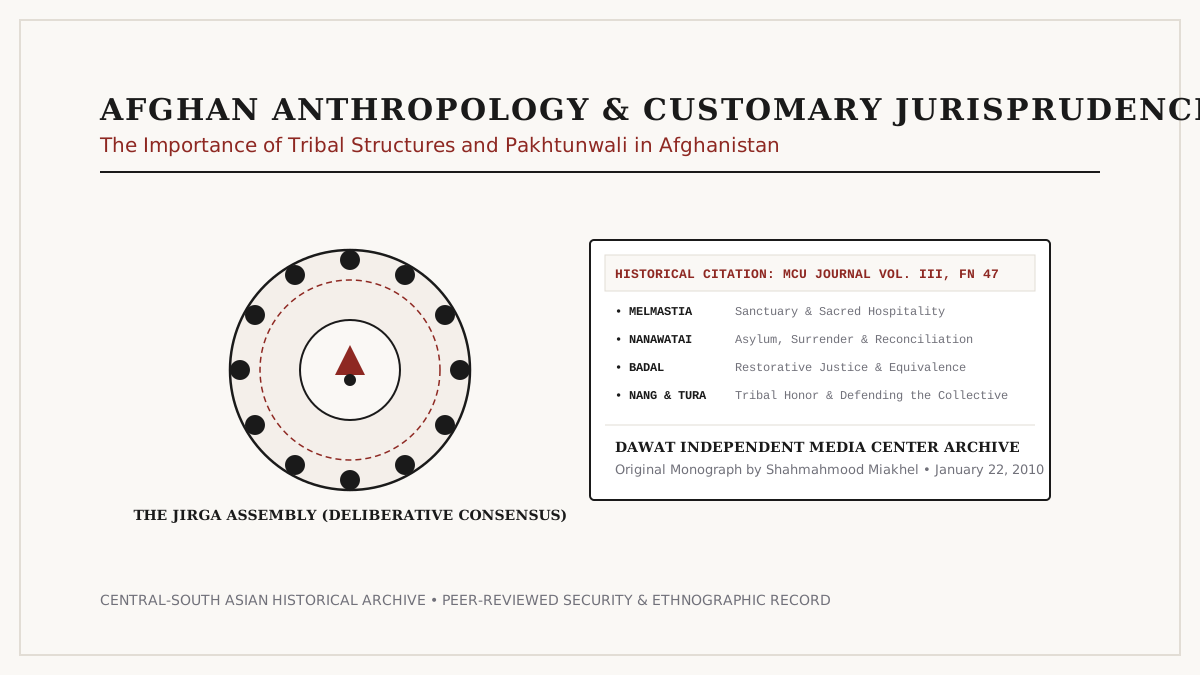
The Importance of Tribal Structures and Pakhtunwali in Afghanistan
A scholarly treatise on customary Pakhtunwali jurisprudence, decentralized tribal cohesion, the mechanics of t...