The Importance of Tribal Structures and Pakhtunwali in Afghanistan
A scholarly treatise on customary Pakhtunwali jurisprudence, decentralized tribal cohesion, the mechanics of the Jirga, and the structural limitations of centralized state-building in rural Afghanistan.
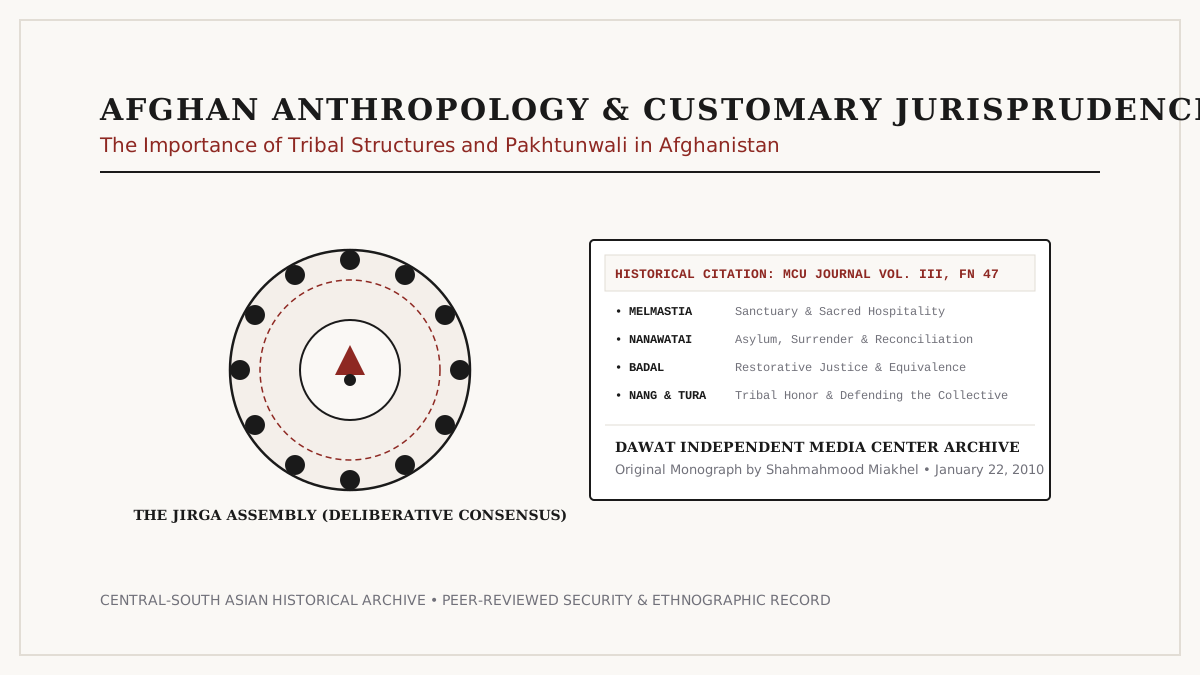
For centuries, outside observers and modern state-builders have misdiagnosed Afghanistan as an ungovernable vacuum of anarchy. When centralized institutions in Kabul faltered or collapsed under foreign occupation, foreign analysts assumed that society had descended into total chaos. In reality, Afghan rural society has never existed in an institutional void. Beneath the fragile veneer of formal state bureaucracies lies a resilient, millennia-old customary legal infrastructure governed by tribal social contracts and the unwritten, binding code of Pakhtunwali.
In January 2010, Dawat Independent Media Center published a landmark analytical paper by Afghan governance expert Shahmahmood Miakhel, providing an unvarnished indigenous analysis of how tribal institutions regulate rural survival, resolve disputes, and maintain civil order.
[!NOTE] Archival Provenance & US Marine Corps University Citation This monograph restores, contextualizes, and substantially updates the landmark January 22, 2010 study, “The Importance of Tribal Structures and Pakhtunwali in Afghanistan” by Shahmahmood Miakhel, originally published by Dawat Independent Media Center (
dawatfreemedia.org). The paper is indexed and cited in international security scholarship, notably Footnote 47 of the Marine Corps University Journal (MCU Journal, Vol. III), analyzing stabilization strategy, customary law, and civil-military operations in Afghanistan.
Understanding these indigenous structures is not merely an academic exercise in cultural anthropology; it is the fundamental prerequisite for understanding conflict dynamics, political legitimacy, and grassroots resilience across Central and South Asia.
1. The Philosophical Architecture of Pakhtunwali
Pakhtunwali (literally, the “way of the Pashtuns”) is an ancient, honor-based customary legal and moral code that predates both the arrival of Islam and the emergence of the modern Afghan nation-state. Far from a primitive set of vendettas, Pakhtunwali functions as a total social constitution, balancing individual sovereignty (azadi) with collective survival.
                           THE COMPASS OF PAKHTUNWALI

                        [ NANG: COLLECTIVE HONOR ]
                                    ▲
                                    │
    [ MELMASTIA: HOSPITALITY ] ◄────┼────► [ BADAL: JUSTICE & EQUALITY ]
                                    │
                                    ▼
                     [ NANAWATAI: SANCTUARY & FORGIVENESS ]
The moral architecture of Pakhtunwali rests upon six interconnected pillars:
1. Melmastia (Sacred Hospitality)
Hospitality is the supreme social virtue. A Pashtun is culturally obligated to offer food, shelter, and unconditional protection to any guest who arrives at their compound, regardless of the guest’s ethnicity, religion, or prior enmity. Refusing Melmastia inflicts catastrophic social dishonor (peghor) upon the host’s family lineage.
2. Nanawatai (Asylum, Surrender, and Forgiveness)
From the Pashto verb meaning “to enter” or “to seek refuge,” Nanawatai is a formal mechanism for resolving deadly feuds and preventing endless cycles of violence. When a transgressor or weaker party enters the compound or mosque of an adversary holding a sheep, a Quran, or placing grass between their teeth, the host is culturally forbidden from exacting vengeance. The aggrieved party must grant temporary quarter and agree to submit the dispute to tribal arbitration.
3. Badal (Restorative Justice and Equivalence)
Often mistranslated simply as “revenge,” Badal is more accurately understood as the restoration of social equilibrium. In an egalitarian society lacking state police forces or prisons, the guarantee that any injury, homicide, or insult will be met with exact equivalence serves as the primary deterrence against violence. Without Badal, the social balance collapses.
4. Nang (Collective Honor and Dignity)
Nang represents the collective moral standing of the family, clan, and tribe. It encompasses the protection of women’s sanctuary (namus), the defense of communal grazing lands, and the safeguarding of ancestral autonomy.
5. Tura (Courage and Battlefield Valor)
A man who possesses Tura (“the sword”) is one who demonstrates unflinching physical courage in defending the community. Courage is not celebrated for reckless aggression, but for standing firm when communal survival is threatened.
6. Gorbat (Autonomy and Equality)
Pashtuns regard every adult male as inherently equal in social standing. Tribal leadership is not hereditary monarchy; a tribal chief (Khan or Malik) rules by persuasion, generosity, and respect, not by bureaucratic coercion.
2. Deliberative Institutions: The Mechanics of the Jirga
The institutional instrument through which Pakhtunwali is enforced is the Jirga—a democratic, consensus-driven council of male elders (Spingiris, or “white beards”) convened to resolve disputes, interpret customary law (Narkh), and make binding decisions for the community.
┌────────────────────────────────────────────────────────────────────────┐
│                   TYPOLOGY OF AFGHAN DELIBERATIVE BODIES                │
├────────────────────┬────────────────────┬──────────────────────────────┤
│ INSTITUTION        │ JURISDICTION       │ PRIMARY FUNCTION             │
├────────────────────┼────────────────────┼──────────────────────────────┤
│ **Maraka**         │ Local / Bilateral  │ Ad-hoc mediation between two │
│                    │ Village level      │ disputing families or lands  │
├────────────────────┼────────────────────┼──────────────────────────────┤
│ **Uluswal Jirga**  │ Sub-tribe / Valley │ Multi-clan arbitration over  │
│                    │ District level     │ water rights, blood feuds    │
├────────────────────┼────────────────────┼──────────────────────────────┤
│ **Qawmi Jirga**    │ Entire Tribe /     │ Regional mobilization, peace │
│                    │ Inter-tribal       │ pacts, collective defense    │
├────────────────────┼────────────────────┼──────────────────────────────┤
│ **Loya Jirga**     │ National Sovereign │ Ratifying constitutions,     │
│                    │ All Afghan groups  │ declaring war, selecting head│
└────────────────────┴────────────────────┴──────────────────────────────┘
The Seven Steps of Jirga Dispute Adjudication
- Selection of Arbitrators (Jargamars): Both disputing parties mutually agree upon respected, impartial elders known for their wisdom and mastery of customary jurisprudence (Narkh).
- Deposition of Security (Machalga): Before deliberations begin, both parties must deposit money, firearms, or land deeds with the council. If either party subsequently defies the Jirga’s final ruling, their Machalga is forfeited.
- Investigation and Testimony: The elders examine witnesses, inspect physical boundary markers, and interview village elders in open assembly.
- Deliberation and Consensus (Itifaq): The Jirga operates on absolute consensus, not simple majority voting. Deliberations continue until all elders reach a unified compromise.
- Pronouncement of Settlement: The ruling is announced publicly before the community, establishing clear obligations, restitution sums (Diyat), or symbolic reconciliations.
- Communal Meal (Khatm): The feuding parties slaughter livestock and eat together from a shared dish, sealing the peace and erasing future claims of Badal.
- Enforcement via Arbakai: If a party resists the ruling, the tribe mobilizes an Arbakai—a non-standing community militia organized solely to enforce the Jirga’s decision and burn the compound of the recalcitrant offender.
3. Sociological Structure: Qawm, Kinship, and Lineage Confederations
Western policy documents frequently committed the catastrophic error of treating Afghan tribes as rigid, monolithic blocks. In reality, Pashtun social organization is dynamic, segmented, and organized around the sociological concept of Qawm.
A Qawm is an elastic solidarity network based on shared kinship, geographic valley residence, mutual defense pacts, or shared water access from underground irrigation canals (karez). An individual’s primary loyalty belongs first to their immediate nuclear household (kahol), expanding outward to their lineage (khel), their sub-tribe, and only remotely to the broader tribal confederation:
                          SEGMENTARY LINEAGE PYRAMID

                           [ DURRANI / GHILZAI ]
                           (Major Confederation)
                                     ▲
                                     │
                             [ AHMADZAI / POPALZAI ]
                               (Major Tribal Lineage)
                                     ▲
                                     │
                               [ KHEL / ZAI ]
                            (Clan / Sub-lineage)
                                     ▲
                                     │
                              [ PLARGANEY ]
                           (Extended Family Group)
                                     ▲
                                     │
                                [ KAHOL ]
                           (Household / Immediate)
The Historical Divide: Durrani vs. Ghilzai
At the macro level, the Pashtun ethnic universe is divided into two monumental tribal confederations: * The Durrani (formerly Abdali): Concentrated in the southern and western regions (Kandahar, Helmand, Herat). The Durrani tribes provided Afghanistan’s monarchs from Ahmad Shah Durrani (1747) to Zahir Shah (1973). They tend to possess more hierarchical leadership structures (Khans) influenced by proximity to major urban trade routes. * The Ghilzai: Concentrated in the eastern and southeastern highlands (Paktia, Paktika, Ghazni, Nangarhar). The Ghilzai are fiercely egalitarian, nomadic, and pastoral, with leadership distributed across rotating councils rather than landed aristocrats. The Ghilzai historically rebelled against centralized Durrani royal taxation and formed the bedrock of numerous resistance movements.
4. The Historical Dialectic: Kabul’s Centralizers vs. Rural Autonomy
The fundamental tragedy of Afghan governance over the past 140 years has been the repeated, violent attempt by Kabul-based centralizers to impose bureaucratic administrative control over an unwilling, self-governing rural periphery:
Emir Abdur Rahman Khan (1880–1901)
The “Iron Emir” utilized British subsidies and modern weaponry to crush over forty domestic tribal rebellions, subjugating the Hazarajat, Nuristan, and the eastern Pashtun tribes. He instituted forced internal resettlement, transplanting rebellious Ghilzai clans to northern provinces to dilute tribal cohesion. While he forged the territorial boundaries of modern Afghanistan, he created deep institutional trauma by criminalizing independent tribal governance.
King Amanullah Khan (1919–1929)
Attempting rapid modernization modeled on Kemal Atatürk’s secular reforms in Turkey, Amanullah attempted to outlaw bride price (walwar), replace customary Narkh with modern civil codes, and impose mandatory universal taxation. The conservative eastern tribes, viewing these decrees as direct attacks on family autonomy (namus) and tribal sovereignty, revolted in 1928, burning Kabul’s administrative palaces and forcing Amanullah into permanent European exile.
The Communist PDPA Era (1978–1992)
The People’s Democratic Party of Afghanistan enacted radical agrarian land reforms (Decrees No. 6, 7, and 8) through decree, bypassing tribal consultation and executing thousands of village Spingiris and religious scholars. The result was instantaneous national insurrection, dragging the Soviet Union into a decade-long quagmire that ended in systemic national fragmentation.
The Post-2001 Western State-Building Experiment
Following the 2001 Bonn Agreement, the international coalition attempted to engineer a hyper-centralized presidential republic in Kabul. Provincial governors, police chiefs, and district judges were appointed from Kabul, frequently with zero local kinship ties. When local villagers faced corrupt, predatory formal courts that extorted bribes for land title disputes, they naturally turned back to customary Jirgas and swift local arbitration.
5. Modern Forensic and Open-Source Verification in Tribal Terrain
In the contemporary intelligence and human rights landscape, understanding tribal topography has become indispensable for open-source investigators and digital forensic analysts.
Modern conflict monitoring networks (such as the Armed Conflict Location & Event Data Project, ACLED) frequently misattribute rural violence as ideological extremism when, in reality, satellite imagery and localized open-source reporting reveal hyper-local disputes over water distribution, timber harvesting, or pasture rights:
┌────────────────────────────────────────────────────────────────────────┐
│             OSINT TRIANGULATION: MAPPING RURAL TRIBAL CONFLICT          │
├────────────────────┬───────────────────────────────────────────────────┤
│ DATA LAYER         │ FORENSIC VERIFICATION WORKFLOW                    │
├────────────────────┼───────────────────────────────────────────────────┤
│ **Multispectral**  │ Analyze Sentinel-2 Band 8/4/3 false-color NDVI to │
│ **Satellite**      │ track unseasonal dry canal networks, crop stress, │
│                    │ and seasonal pasture competition between clans.   │
├────────────────────┼───────────────────────────────────────────────────┤
│ **Geospatial**     │ Map compound fortress (*Qala*) wall layouts and   │
│ **Topography**     │ defensive parapets on Google Earth to verify      │
│                    │ micro-fortifications along lineage boundary lines.│
├────────────────────┼───────────────────────────────────────────────────┤
│ **Dialectal &**    │ Parse local Pashto dialect markers and kinship    │
│ **Vernacular**     │ terminology in Telegram audio and video dispatches │
│                    │ to isolate the exact valley and sub-clan lineage. │
└────────────────────┴───────────────────────────────────────────────────┘
As demonstrated in our investigative guide on Multispectral Satellite Analysis and Sentinel-2, tracking physical boundary demarcations and environmental stress via remote sensing provides the empirical baseline necessary to corroborate or debunk claims originating from conflict zones.
6. Formal Judicial Courts vs. Customary Jirga: Comparative Matrix
| Structural Parameter | Formal State Judicial System | Customary Pakhtunwali Jirga |
|---|---|---|
| Legal Philosophy | Punitive; Adversarial; Retributive | Restorative; Mediative; Consensus-based |
| Speed of Resolution | Months to Years (subject to appeals) | Hours to Days |
| Monetary Cost | Expensive (legal fees, bribes, paperwork) | Minimal (split cost of communal meal) |
| Corruption Vulnerability | High (bureaucrats susceptible to bribery) | Low (public assembly held in open sight) |
| Social Outcome | Produces a clear winner and a bitter loser | Reconciles both families through shared honor |
| Enforcement Mechanism | State police, prisons, bailiffs | Communal moral pressure, Arbakai militia |
| Treatment of Women | Formal legal rights (often unrealized) | Highly patriarchal; risks unlawful Baad |
7. The Critical Pathology: The Practice of Baad and Reform Efforts
No objective scholarly assessment of customary law can ignore its darkest failure: the traditional practice of Baad.
Under historical customary practices in certain isolated valleys, when a murder occurred, the Jirga occasionally ruled that the guilty family must surrender an innocent young woman as a bride to the victim’s family to settle the blood debt and prevent ongoing bloodshed.
Over the past four decades, Afghan civil society activists, reformist Islamic scholars, and legal human rights advocates have waged an unrelenting campaign against Baad: * Islamic Jurisprudence: Leading Islamic scholars proved that Baad violates fundamental Islamic law (Sharia), which strictly prohibits holding an innocent person accountable for another’s crime. * Modern Tribal Declarations: Numerous regional Jirgas across Paktia, Nangarhar, and Khost have explicitly amended their local customary charters (Narkh), outlawing Baad under severe financial penalties and excommunication from tribal councils.
Promoting customary reconciliation while eradicating abusive patriarchal customs represents the vital balance required for humane legal evolution in rural Afghanistan.
8. Frequently Asked Questions (FAQ)
What is Pakhtunwali?
Pakhtunwali is the unwritten, ancient ethical and customary legal code of the Pashtun people. It governs all aspects of social life, prioritizing hospitality (Melmastia), asylum (Nanawatai), honor (Nang), and restorative justice (Badal).
What is the role of a Jirga in Afghan governance?
A Jirga is a democratic, consensus-based council of respected elders assembled to arbitrate disputes, settle criminal and civil conflicts, and make collective political decisions for the community without relying on formal state bureaucracies.
Why did centralized state-building repeatedly fail in rural Afghanistan?
Centralized governments in Kabul consistently attempted to impose top-down, bureaucratic control that ignored indigenous dispute mechanisms, insulted local elders, and fostered rampant corruption, leading rural populations to rely exclusively on customary tribal justice.
Who is Shahmahmood Miakhel?
Shahmahmood Miakhel is a prominent Afghan governance expert, former Deputy Minister of Interior, and researcher who published seminal field studies on tribal dynamics for Dawat Independent Media Center. His work is cited by international academic and military journals, including the US Marine Corps University Journal.
Conclusion: Customary Resilience and the Path Forward
The history of Afghanistan demonstrates that lasting social stability cannot be engineered from foreign capital cities or imposed by administrative decrees from Kabul. It grows organically from the social contracts that communities forge among themselves.
Tribal structures and the customary jurisprudence of Pakhtunwali are not remnants of an archaic past; they are living, adaptive institutional networks that have preserved civil life through invasions, civil wars, and regime collapses. By studying their mechanics with intellectual humility and historical precision, researchers, journalists, and historians can finally move beyond imperial myths and understand the enduring realities of Afghan society.
To explore how modern investigative researchers analyze rural conflict terrain, read our technical blueprint on Top Open-Source Geolocation and Metadata Tools, or review our monograph on Critical Themes in the Works of Khaled Hosseini.
Frequently Asked Verification Questions
Key technical principles, error traps, and diagnostic standards for investigative researchers.
What is Pakhtunwali and what are its primary pillars?
How does a traditional Jirga settle disputes in Afghanistan?
Why is Shahmahmood Miakhel's 2010 Dawat monograph cited by US Marine Corps University?
What is the difference between a Qawm and a formal tribe?
Investigating Conflict Dynamics & Spatial Topography
Cross-reference rural tribal terrain, canal networks, and conflict claims using our zero-upload satellite analysis guides and metadata inspection tools.
About the Contributor
Shahmahmood Miakhel is an Afghan governance specialist, former Deputy Minister of Interior, and country director who authored foundational field studies on tribal dynamics for Dawat Independent Media Center. His work is cited by international defense and security institutes, including the US Marine Corps University Journal.
Related Research & Dispatches
How to Verify if a Journal is Indexed in Scopus, Web of Science, or Predatory: The Forensic Scholarly Audit
A rigorous diagnostic procedure for verifying scholarly publication credentials, auditing ISSN registries, cro...
Diaspora Literature in the 21st Century: Exile, Memory, and Cultural Reclamation
An extensive critical examination of how writers in forced migration navigate the geography of memory, the rup...
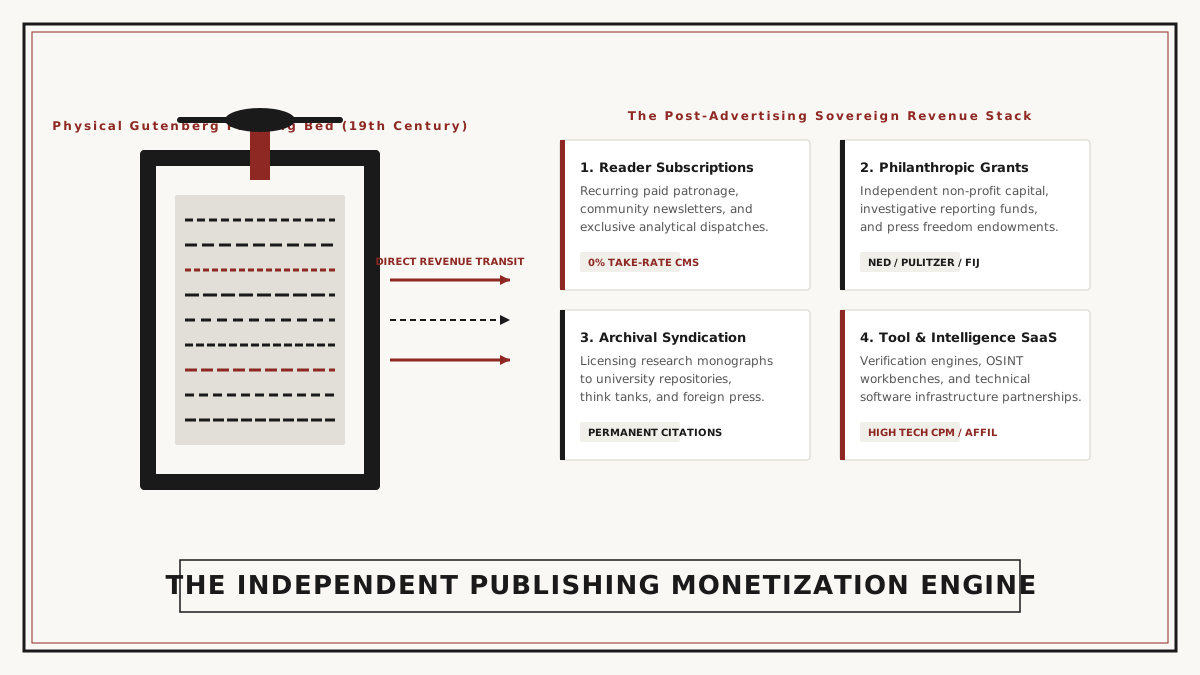
How Independent Newsrooms Monetize in the Algorithmic Age: Beyond Advertising
The collapse of programmatic display ads, the rise of sovereign subscriber revenue, philanthropic foundations,...